What is the hip?
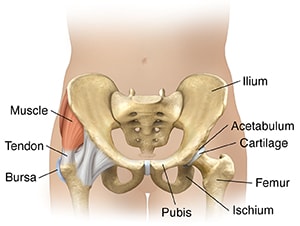
The hip is the area on each side of the pelvis. The pelvis bone is made up of three sections:
- Ilium. This is the broad, flaring portion of the pelvis.
- Pubis. This is the lower, rear part of the pelvis.
- Ischium. This is one of the bones that helps form the hip.
The hip joint is a ball-and-socket joint that allows motion and gives stability needed to bear body weight.
The socket area (acetabulum) is inside the pelvis. The ball part of this joint is the top of the thighbone (femur). It joins with the acetabulum to form the hip joint.
The hip is one of the most stable joints in the body. But because it bears your body weight, it's more likely to develop arthritis because of the extra pressure. Pain in the hip may be caused by injury to muscles, tendons, or the small fluid-filled sacs (bursae) that cushion and lubricate joints.
What are common hip problems?
The following are some of the most common hip problems:
Arthritis
Arthritis is the most common cause of the breakdown of hip tissue. Three kinds of arthritis commonly affect the hip:
- Osteoarthritis. This is also referred to as "wear and tear" arthritis. This type of arthritis damages the cartilage that cushions the bones of the hip wearing away. This lets the bones then rub together, causing hip pain and stiffness.
- Rheumatoid arthritis. This disease causes the lining of the joint (synovial membrane) to become inflamed. It damages the cartilage, leading to pain and stiffness.
- Traumatic arthritis. This is often the result of an injury or fracture.
Bursitis
With bursitis, the fluid-filled sac (bursa) in the joint becomes inflamed. The bursa functions as a gliding surface to reduce friction between tissues. There are two major bursae of the hip. Both can cause stiffness and pain around the hip joint.
- Trochanteric bursa. The bursa on the side of the hip and separated from the actual hip joint by tissue and bone.
- Iliopsoas bursa. The bursa on the inside (groin area) of the hip.
Other common hip problems:
- Avascular necrosis. This condition involves death of bone tissue from a lack of blood supply. The blood supply to the bone can drop off for many reasons. Corticosteroid medicines can cause avascular necrosis in some people. It can also be caused by injury or bone tumors. It may lead to breakdown and collapse of the hip joint.
- Hip pointer. A bruise or tear in the muscle that connects to the top of the ilium. The ilium is the crest of the pelvis, just below the waist. Causes of a hip pointer may include a blow, a fall, or a quick twist or turn of the body.
Date Last Reviewed: 09/01/2025
© 2000-2026 The StayWell Company, LLC. All rights reserved. This information is not intended as a substitute for professional medical care. Always follow your healthcare professional's instructions.Related Articles
Knee Pain
Knee pain is very common. Here is general information about symptoms, diagnosis, and treatment.
Knee Ligament Injuries
Learn about the 4 major ligaments of the knee, and about common injuries, symptoms, and treatment.
Knee Replacement Surgery
When your knee is badly damaged by disease or injury, a knee replacement may be considered. During knee replacement surgery, your joint surfaces are replaced by prostheses. These are plastic and metal parts that are used to replace your joint surfaces. Read on to learn more.
Total Hip Replacement
Total hip replacement surgery almost always reduces joint pain. During this surgery, your problem hip joint is replaced with an artificial joint, called a prosthesis.
Related Providers

John M Tozzi
Hip and Knee Orthopedic Surgery
Accepting new patients
Jersey Shore University Medical Center

Dr. Ronald Hugate Jr, MD
Orthopedic Surgery +2 more
Accepting new patients



Dr. Peter Lammens Jr, MD
Orthopedic Surgery +1 more
Accepting new patients
