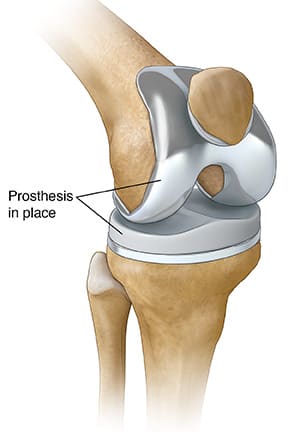
During total knee replacement surgery, your damaged knee joint is replaced with an artificial joint, called a prosthesis. This surgery almost always reduces joint pain and improves your quality of life.
Before your surgery
You will most likely arrive at the hospital on the morning of the surgery. Follow all your doctor's instructions on preparing for surgery.
- Follow any directions you are given for taking medicines and for not eating or drinking before surgery.
- At the hospital, your temperature, pulse, breathing, and blood pressure will be checked.
- An I.V. (intravenous) line will be started to give you fluids and medicines during surgery.
The procedure
When the surgical team is ready, you'll be taken to the operating room. There you'll be given anesthesia to help you sleep through surgery. One common type of anesthesia is general anesthesia (you are put to sleep). Others are spinal, epidural, or regional nerve block anesthesia. For these, you are awake, but your body is numb from the waist down. The anesthesia team will talk with you to determine which type of anesthesia will be best for you. Then a cut is made on the front or side of your knee. Any damaged bone is cleaned away. The new joint parts are put into place. The cut is closed with surgical staples or stitches.
After your surgery
After surgery, you'll be sent to the recovery room. The nurses will give you medicines to ease your pain. You may have a small tube (catheter) in your bladder. In some cases, a continuous passive motion machine may be used on the knee to keep it from getting stiff. A sequential compression machine may be used to prevent blood clots by gently squeezing then letting go of your lower leg. You may be given medicine to prevent blood clots. Soon, you will get help to get up and moving.
When to contact your doctor
Once you're back home, call your doctor if you have:
- Trouble breathing or chest pain (call
911 ). - An increase in knee pain.
- Pain, redness, or swelling in the calf or leg.
- Unusual redness, heat, or drainage at the incision site.
- Bleeding that soaks your bandages.
- A fever of 100.4°F (38°C) or higher, or as directed by your doctor.
- Shaking chills.
Online Medical Reviewer: Rahul Banerjee MD
Online Medical Reviewer: Raymond Turley Jr PA-C
Online Medical Reviewer: Stacey Wojcik MBA BSN RN
Date Last Reviewed: 09/01/2025
© 2000-2026 The StayWell Company, LLC. All rights reserved. This information is not intended as a substitute for professional medical care. Always follow your healthcare professional's instructions.Related Articles
Knee Pain
Knee pain is very common. Here is general information about symptoms, diagnosis, and treatment.
Knee Pain and Problems
Common knee problems include sprains, strains, torn cartilage, and arthritis.
Knee Replacement Surgery
When your knee is badly damaged by disease or injury, a knee replacement may be considered. During knee replacement surgery, your joint surfaces are replaced by prostheses. These are plastic and metal parts that are used to replace your joint surfaces. Read on to learn more.
Knee Ligament Injuries
Learn about the 4 major ligaments of the knee, and about common injuries, symptoms, and treatment.
Related Providers

John M Tozzi
Hip and Knee Orthopedic Surgery
Accepting new patients
Jersey Shore University Medical Center


Dr. Ronald Hugate Jr, MD
Orthopedic Surgery +2 more
Accepting new patients